
India Has No Plan B
We built the payments rail the world copied. We are renting everything else — including our intelligence — from someone else. And we are completely fine with it.

On June 12, 2026, at 5:21 PM ET, the US government issued an export-control directive to Anthropic. Within hours, Claude Fable 5 and Mythos 5 were disabled globally. Not for users in a rival nation. For everyone — including India, which had been granted access just days earlier.
One directive. One evening. Gone.
India has been here before — except last time, we were the ones flipping the switch.

The Rail We Built
Let’s start with what India actually did right. Because it is genuinely extraordinary.
UPI. 172 billion transactions in 2024. $2.7 trillion moved. Free. Open. Interoperable. A piece of Indian public infrastructure already playing in the same league as Visa (234 billion transactions) and Mastercard (160 billion) — and growing faster than both. At zero cost to consumers.
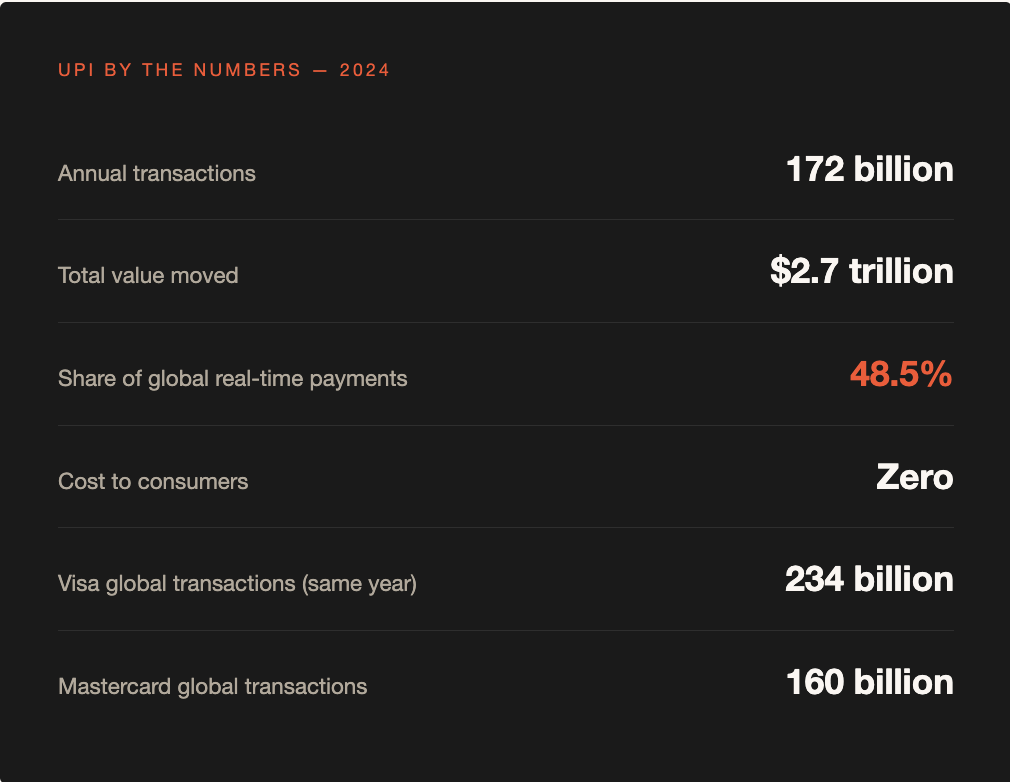
India accounts for 48.5% of all real-time payments on earth. We did not copy this. There was no template. We built it from first principles, and the world is still catching up.
Brazil built Pix in its image. Singapore built PayNow. The US Federal Reserve built FedNow. They all looked at what India did and said: we need that.
That is what building the future looks like.
What We Did With the Rail
India now has 10,200 fintech startups. The ecosystem has attracted over $32 billion in funding since 2014. By every headline metric, India owns digital payments.
But here is the honest question nobody asks loudly enough: what are those 10,200 startups actually building?
Most are building on the rail — BNPL products, payment wrappers, credit overlays, investment apps. UPI operates at near-zero cost domestically, making direct monetisation nearly impossible. So the real margin accrued to Walmart (PhonePe) and Google (GPay), who together command 84% of UPI transaction volume.
We built the infrastructure. Someone else captured the value sitting on top of it. That is not a failure. It is a pattern worth recognising — before we repeat it in AI.
The UPI story has a quiet irony at its centre: India created one of the most powerful fintech platforms in history, and handed the consumer layer to two American corporations. The highway is ours. The toll booths belong to someone else.
The Quick Commerce Chapter
India built a $6 billion quick commerce market. Proved that 10-minute delivery at scale is operationally possible in a country with India’s infrastructure complexity. That execution muscle is genuinely world-class.
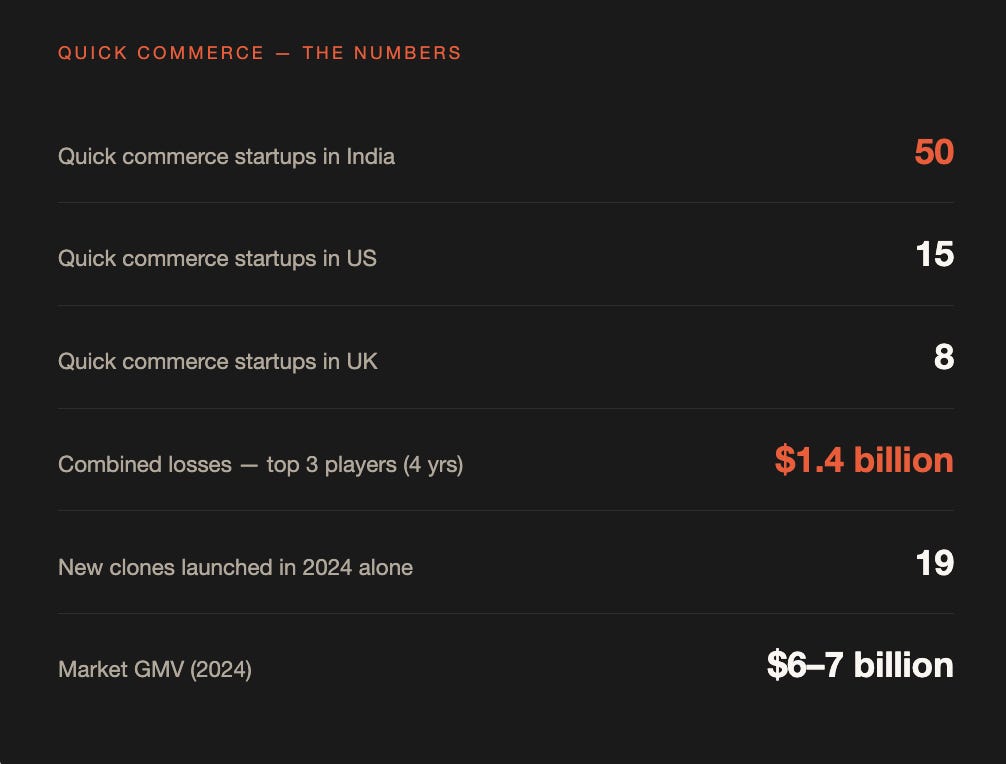
Quick commerce gave India proof of execution. A generation of founders who know how to build fast, iterate ruthlessly, and scale operationally complex businesses. That capability matters.
But 50 startups chasing the same dark store playbook in the same cities — that is not innovation compounding. That is capital concentrating around a proven template with diminishing returns. Execution speed pointed at a local delivery race is not the same as execution speed pointed at a decade-long technology frontier.
We already know how to move fast. The question is whether we choose to move far.
The Frontier We Are Underinvesting In
India has 4,200 active deep tech startups, with over 550 added in 2025 alone. Deep tech funding reached $2.3 billion in 2025 — a 37% jump year on year.
Now compare it to where the real competition is playing:
— India: 5% of total startup capital goes to deep tech
— China: 35% of VC goes to deep tech
— United States: ~50% of all VC captured by AI alone in 2025
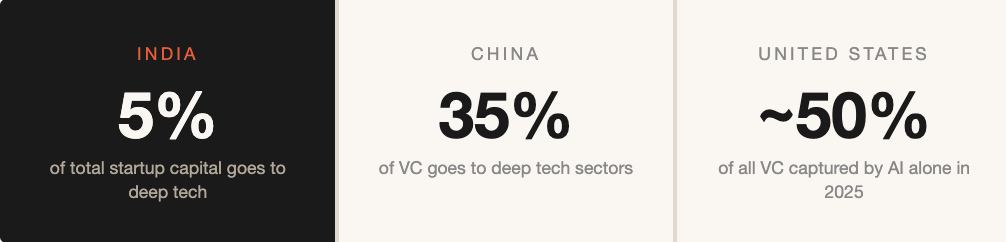
5% versus 35% versus 50%. Those are not minor differences in emphasis. They are structural choices about what kind of technology economy a country wants to become.
We have the engineers. We have the IITs and IIScs producing world-class STEM talent. We have a government that has finally put serious capital behind semiconductors, space, and AI infrastructure. The seeds are planted.
What is still scarce is patient capital — the kind that waits 8 years for a breakthrough instead of 8 months for a GMV milestone. Less than 3% of India’s 800 climate tech startups have raised Series B or beyond. The pattern repeats across biotech, space, and quantum: seed money flows in, then the capital dries up when things get hard and exits aren’t visible.
Sarvam: A Brilliant First Step
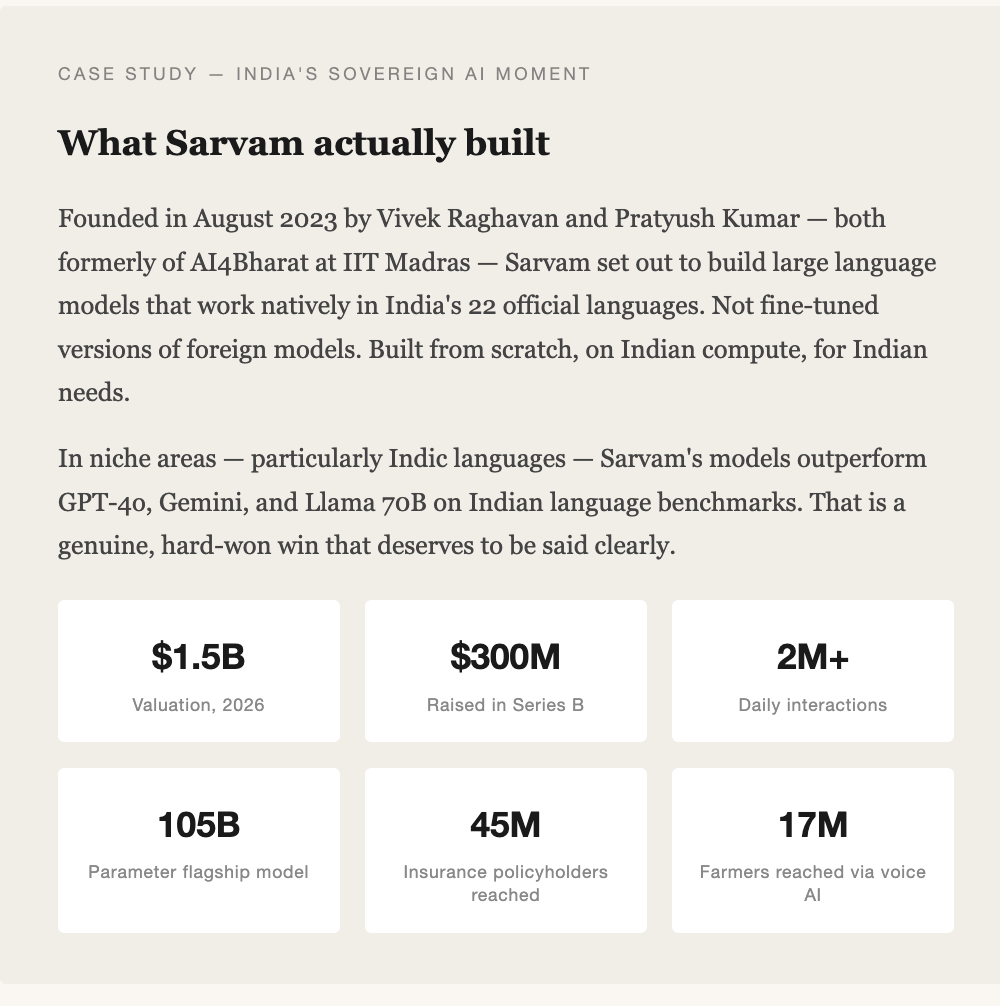
Sarvam is the most important story in Indian tech right now. Not because it has won. But because it is the first credible attempt to build the thing that actually matters: a sovereign AI stack built by Indians, on Indian infrastructure, for Indian needs.
And yet. Frontier models from OpenAI, Anthropic, and Google operate on a different scale altogether — trained on trillions of tokens, with compute budgets that dwarf India’s entire IndiaAI Mission allocation. Sarvam is competitive within its domain. It is not yet global in the way UPI became global.
Sarvam is the Mangalyaan moment for Indian AI. Proof that we can do it, at a fraction of the cost, with a fraction of the resources. One Sarvam is a start. We need ten.
The Switch That Gets Flipped
Think about it seriously for a moment.
What if tomorrow, amid a geopolitical shift, the US restricts AI model access to India? What if India’s own government — rightly concerned about data sovereignty — decides foreign AI models cannot operate on Indian citizen data? What if Claude, ChatGPT, and Gemini get treated like a national security threat overnight?
Sounds remote? Dramatic?
We don’t need to imagine this. We already lived it. Twice.
June 2020 — India banned 59 Chinese apps overnight. TikTok, WeChat, UC Browser, ShareIt — gone. TikTok had over 200 million monthly active users in India. India was TikTok’s biggest market in the world. One order. One night. No transition period. No appeals process.
June 2026 — India was granted access to Anthropic’s Fable 5 and Mythos 5. Days later, the US government issued an export-control directive. Anthropic disabled both models globally. As Anthropic put it: “The net effect of this order is that we must abruptly disable Fable 5 and Mythos 5 for all our customers to ensure compliance.” India’s access: revoked.
We did that to China’s apps in 2020. We know exactly how it works. We know how fast it happens.
Now turn the mirror around.
“You should not confuse access with ownership, or adoption itself as advantage. And if the most significant tech differentiator you are leveraging has external control loops, then you have to accept you are vulnerable.”
— Sarvam AI CEO, on the Fable ban
European leaders are already calling AI dependency a kill switch. “Europe cannot keep building its tech stack on access that can be switched off overnight by a foreign government.” They are rattled. And Europe has Mistral. Europe has been investing in sovereign tech for decades. Europe has a plan.
India has been granted access, had it taken away in the same week, and is still not treating this as the emergency it is.
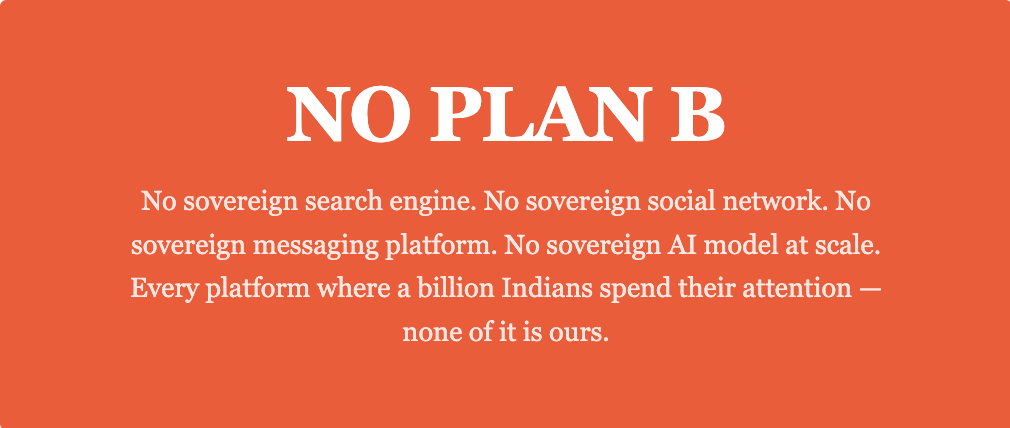
We have no sovereign search. No sovereign social network. No sovereign messaging platform. No sovereign AI model at scale. Every platform where a billion Indian citizens spend their digital lives — WhatsApp, Google, Instagram, YouTube, ChatGPT — none of it is ours. We don’t own the pipes. We don’t own the models. We don’t own the data layer built on our own citizens’ behaviour.
And we are taking it easy.
What History Tells Us
India Stack took 8 years to build. UPI took 3 more to go global. Mangalyaan reached Mars at a fraction of what NASA spent. None of it happened because it was the easy or obvious choice. None of it had a guaranteed return at year one.
It happened because someone decided the long game was not optional.
Sovereign AI is not optional anymore. Not after June 12, 2026. The Anthropic export ban showed the world — showed India specifically — that access can be suspended in a single evening, for reasons that have nothing to do with India’s interests.
We built UPI when nobody thought we could. We banned 59 apps overnight when we had to. We can build what we need. The question is whether we wait until we have to — or start now while we still have the luxury of choosing.
The shortcut is the risk.
The long game is the edge.
And the clock is no longer theoretical.
India’s next chapter will not be written in dark stores.
It will be written in foundation models, sovereign infrastructure, and the stubborn belief that a billion-person democracy cannot afford to rent its intelligence from someone else.
If this was useful, the best thing you can do is subscribe to Ground Truth and forward it to one person who keeps confusing model benchmarks with company strategy.
Srinivas Mullapudi has spent 20 years building enterprise products, data platforms, AI pipelines, and product organizations at the intersection of enterprise software and emerging tech. Ground Truth covers what’s really happening in AI and tech, not what the pitch decks say, with occasional detours into career and the messier questions that resist easy frameworks. Check out his portfolio.