
Shift Right
You've heard of Shift Left in engineering — moving testing earlier so problems get caught before they're expensive. AI is doing the same thing to product management. Except the direction is opposite.

A startup with 4 founders and 300 employees just beat Microsoft.
Cursor — an AI code editor — went from $0 to $3B ARR in under two years. Microsoft’s GitHub Copilot had a three-year head start. 26 million users. The entire Azure stack behind it. Every enterprise relationship money can buy.
Cursor beat them anyway.
Not because they had better technology. The underlying models were identical — available to anyone who wanted them.
They won because they understood how it feels to be a developer mid-flow. The broken context. The cognitive tax of switching windows. The frustration of explaining what you’re trying to build to a tool that doesn’t actually care.
They didn’t out-build Microsoft. They out-understood the developer.
That gap — between building and understanding — is where this entire industry is being re-organized right now.
The old shape of PM work
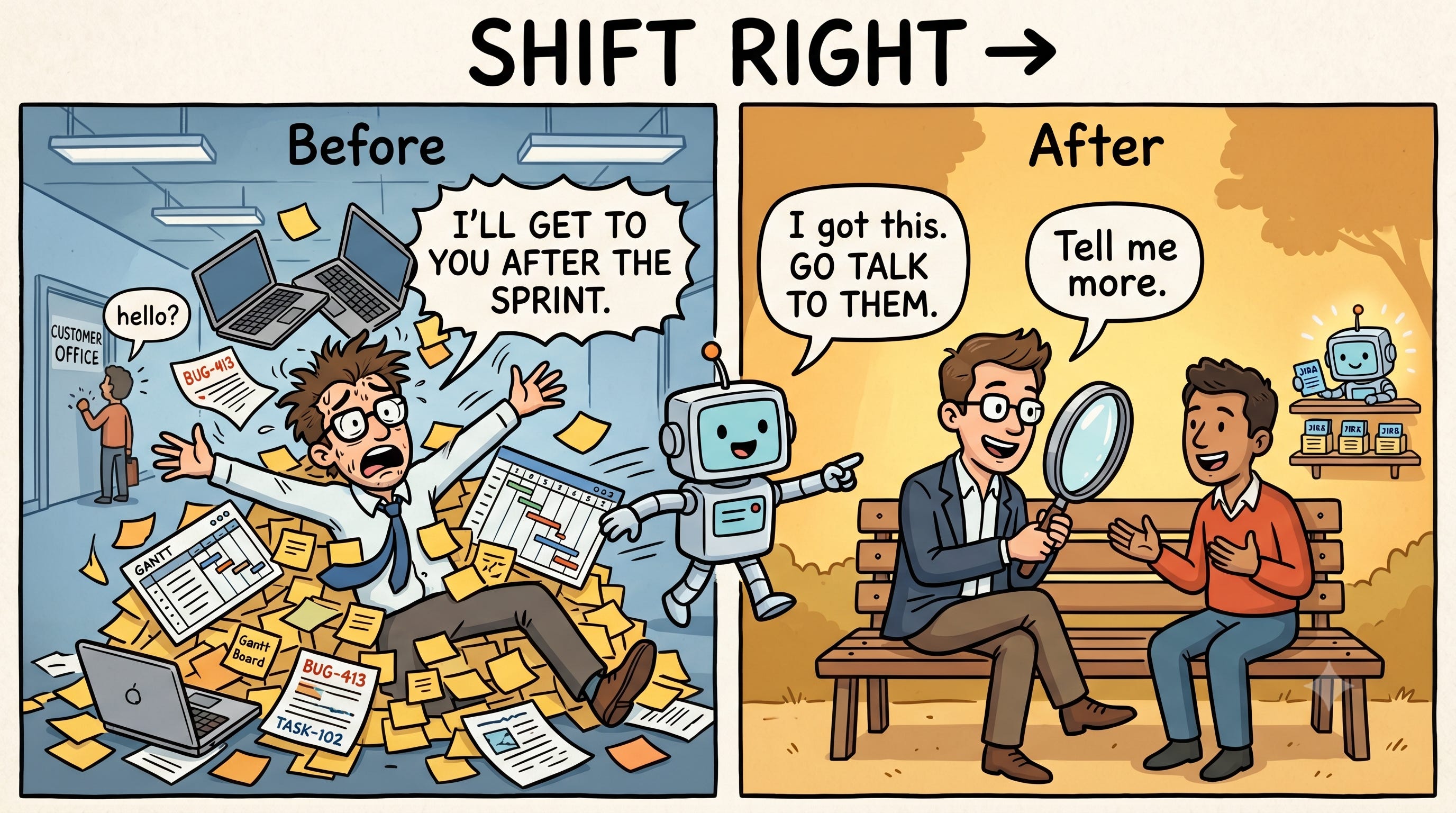
For two decades, the dirty secret of product management was this: we spent most of our time facing left.
Left toward engineering. Left toward technical scoping, sprint planning, backlog grooming, architecture debates. Left toward all the complexity of making the thing.
And for good reason — building software was genuinely hard, slow, and expensive. Every decision about what to build had to be weighed against the cost of building it. The PM sat at the center because someone had to translate between what the customer wanted and what engineering could actually do.
Technology was the constraint. So technology consumed the attention.
Pragmatic Marketing once surveyed product managers and found that only 28% reported spending any time on strategy. The remaining 72% were deep in tactics and execution. And 61% — more than half — said they wished they could spend more time on strategy but couldn’t get there.
52% of PM time went to unplanned fire-fighting.
Not discovery. Not customer conversations. Fire-fighting.
The customer was always the stated priority. But in practice, engineering was the gravitational center. Everything orbited it.
What AI is doing
In 2025, Andrej Karpathy coined the term “vibe coding” — describing software requirements in natural language and letting AI generate the code. By the end of that year, Collins Dictionary named it Word of the Year.
By 2026, the numbers tell you exactly what’s happening:
92%. of US developers use AI coding tools daily
60% of all new code in 2026 is AI-generated
95%. of some YC W25 codebases were AI-written
$3B ARR Cursor reached in under two years
The cost of building collapsed.
Which means the old constraint — the thing that pulled everyone’s attention left — is gone.
The 2026 CPO Insights Report, drawn from 1,500 product leaders across Fortune 1000 companies and startups, put it plainly: “Bottlenecks have shifted from building to launching: go-to-market execution, customer adoption, and organizational alignment are now where products get stuck.”
The engineering wall is coming down. And there’s less and less between the PM and the customer.
That’s the Shift Right. And it’s happening now.
Every PM fundamental is being challenged
Shift Left in DevOps meant: don’t wait for problems to surface in production. Catch them earlier, where they’re cheaper to fix.
Shift Right in PM means the same thing, but for customer understanding. Don’t wait for customers to churn, complain, or stop adopting before you engage. Get there earlier, deeper, continuously.
Here’s how it plays out across every core area of PM:
Discovery: from phase to posture
Discovery used to be a project. You’d run user interviews for a quarter, build a persona, write it up, and move into execution mode. Then you wouldn’t resurface for six months.
That rhythm made sense when execution was slow. When a feature took three months to ship, you needed long research cycles to justify the investment.
Now features ship in weeks. Sometimes days. The discovery that justified a three-month build doesn’t have time to be a project anymore — it has to be continuous.
The PMs pulling away from the pack right now aren’t running better research sprints. They know their top 20 customers by name. They’re in the Slack communities on a Tuesday afternoon, not to gather data — to understand what their customers are actually trying to do with their lives.
Discovery is shifting right. It’s not upstream of execution anymore. It runs alongside it, every week.
Strategy: from feature gaps to human insights
The old PM strategy playbook: analyze the competitive landscape, find the feature gap, build the missing thing before the competitor does.
That worked when features were hard to build. Now they aren’t.
Figma entered a market Adobe had dominated for two decades. On a feature-gap analysis, attacking them made no sense. But Figma saw something that didn’t show up in a competitive matrix: designers felt isolated. They were throwing work over a wall. Design was treated like a sequential handoff, not a collaborative act. Figma made design a team sport.
That was a human insight. Not a product one. The features followed the insight, not the other way around.
Canva saw something similar — millions of people who had design needs but were embarrassed to call themselves designers. Duolingo understood that language learning isn’t primarily an information problem — it’s a confidence and shame problem. The owl, the streaks, the micro-friction that makes you feel like you earned the progress — all of it traces back to a deep understanding of how humans feel when they’re trying to learn something hard.
When anyone can copy your features in a week, a feature advantage lasts a week. A human insight — genuinely held, operationalized across the product — lasts years.
Roadmaps: from output lists to outcome bets
The traditional roadmap tells the story of what the team will build. Features, timelines, priorities. Organized around output — the things engineering will deliver.
Andrew Ng recently observed something structural: as AI accelerates engineering output, teams are switching from roughly 1 PM per 4 engineers to something closer to 2 PMs per 1 engineer. When building is cheap, the ratio of deciding what to build to building it has to change.
The roadmap has to change with it. Not “12 features this quarter” — but “one outcome we’ll measurably shift in our customers’ lives.” The features are the how. The outcome is the what. Most roadmaps still organize around the how.
The 2026 CPO Insights Report shows CPOs spending 74% of their time on strategy (up from 69% last year) and significantly less on roadmap development (down to 10%). The most ambitious CPOs are now directly owning positioning, adoption, and monetization — territory that used to belong to marketing and sales.
The roadmap is shifting right. It now needs to read as a customer journey, not a sprint plan.
Metrics: from lagging signals to customer proximity
Most PM dashboards measure things that are one or two steps removed from the customer. DAU. Retention rate. Conversion. These are the echoes of customer behavior, not the behavior itself.
Amazon built its entire operating model around a different idea: optimize inputs, not outputs. Don’t track stock price — track delivery speed. Don’t watch NPS — watch support ticket resolution time. Don’t measure DAU — measure the number of customers who completed their first meaningful action.
The output metrics are lagging. By the time they move, the customer decision was made three months ago. Input metrics give you proximity — they tell you what’s happening before it shows up in the numbers you report to the board.
Companies that lead in customer experience grow revenues 4–8% faster than the market, per Bain & Company. Compounded over five years, that gap is the entire game.
Jeff Bezos kept an empty chair in every meeting. Not symbolic. Operational. The customer was always in the room, even when no customer was present.
Go-to-market: from launch events to adoption loops
The traditional GTM motion was a launch. You built a thing, you announced it, you handed it to sales. Done.
That model breaks when building is cheap, because your competitor launches the same thing two weeks later. The launch advantage disappears.
The companies winning on GTM right now aren’t launching better — they’re building communities that absorb customers before a competitor can reach them. Notion didn’t fight Confluence on features. They showed up where their users already gathered, let the community build the templates, and turned users into the distribution channel. Figma let designers build their personal brands by contributing templates and UI kits — turning user output into platform growth.
The 2026 CPO Insights Report called it explicitly: the blurring of lines between product and marketing, as CPOs take direct ownership of positioning and adoption.
GTM is shifting right too. Into a continuous loop that the customer runs.
The honest truth good PMs already knew
Here’s what nobody writing about AI wants to say:
The best PMs were already doing this.
The PMs who built great products — the ones everyone points to as examples — weren’t great because they managed sprints well. They were great because they lived in their customers’ shoes. They spent disproportionate time with customers. They obsessed over the problem, not the execution. They could describe their user’s day more vividly than their user could.
Teresa Torres built an entire body of work around continuous discovery — the idea that talking to customers shouldn’t be a quarterly project but a weekly habit. That was 2021. The idea wasn’t new even then.
Jeff Bezos’s empty chair. Amazon’s press release written before a line of code. Working backwards from the customer, not forwards from the technology. That’s been the gospel for twenty years.
The gap was never knowledge. It was permission.
Permission to spend a full day with a customer instead of in a sprint review. Permission to push back on a feature request because the underlying problem hadn’t been understood well enough. Permission to say “we’re building the wrong thing” after the roadmap was already committed.
Engineering complexity stole that permission. The backlog was always on fire. The sprint was always behind. There were too many layers between the PM and the customer — standups, escalations, dependency meetings, stakeholder alignment — and too little time left over for the actual work of understanding.
AI is removing those layers.
Not all of them, not overnight. But the gravitational pull of the technical left is weakening. The cost of building is collapsing. The excuse of “we don’t have bandwidth for more customer research” is getting harder to make with a straight face when prototypes get built in hours.
The Shift Right isn’t a new idea. It’s an old idea that finally has no excuse not to happen.
So if you were one of those PMs who always believed in getting closer to the customer but felt the system pulling you back toward the backlog — this is your moment.
And if you weren’t — this is your wake-up call.
The PM role isn’t disappearing. It’s shifting.
The 2026 CPO Insights Report predicts the traditional PM role will be obsolete by 2030. That’s a provocative headline. The underlying dynamic is more precise: the PM who spends most of their time coordinating engineering and managing backlogs is solving a problem that is getting solved for them.
What remains — what AI cannot do — is genuine human understanding of another human’s context, frustration, ambition, and daily reality.
That’s the role. That was always the role. We just had a twenty-year detour through the technical left.
The Shift Right is bringing us back.
Toward the customer. Toward the insight that precedes the feature. Toward the understanding a competitor cannot copy because you earn it by being there — in the conversation, in the moment, without layers in the way.
What Shift Right looks like on a Monday morning
You don’t tear up your roadmap. You don’t cancel sprint planning.
But you ask different questions.
When did you last spend a full day with a customer — not selling, not demoing, just watching them work?
How many of your last ten prioritization decisions were driven by what a customer said versus what engineering requested?
Does your roadmap tell your customer’s story or your team’s output story?
The bottleneck is moving. The question is whether your attention is moving with it.
Cursor didn’t out-engineer Microsoft. They out-understood the developer.
That’s the whole game now.
The most powerful PM skill in the age of AI is not prompting.
It’s listening.
And now, finally, there are no more excuses not to.
Srinivas Mullapudi has spent 20 years building data platforms, AI pipelines, and product organizations at the intersection of enterprise software and emerging technology. This newsletter is about what’s actually happening in AI and tech — not what the pitch decks say. Sometimes he wanders off into life, career, and the messier questions that don’t have a framework.
#AgenticAI #EnterpriseAI #AIStrategy #ProductLeadership #DataTrust #AIAgents #FutureOfWork #AILeadership #GenerativeAI #DigitalTransformation #ProductManagement #AIGovernance
Sources & further reading
The collapse of building costs
Vibe Coding Statistics & Trends 2026 — Second Talent ↗
Democratizing Software Engineering through Generative AI — ResearchGate ↗
Vibe Coding 2026: Complete Developer Guide — Lushbinary ↗
Cursor’s rise
Cursor Statistics 2026 — Gradually.ai ↗
Cursor AI Hits $2B Revenue — Digital Applied ↗
Cursor — CNBC Disruptor 50 ↗
PM time allocation & role shift
Product Management Statistics — UXCam ↗2026 CPO Insights Report — PR Newswire ↗
What 1,500 CPOs Say About Their Future — Products That Count ↗
Customer-led company examples
Community-Led Growth: Duolingo, Figma, Notion, HubSpot — Social+ ↗
How Duolingo, Notion and Figma Design with AI — ADPList ↗
Go-to-Market Motions Explained — Medium ↗
Amazon’s Working Backwards
Amazon’s Customer Obsession — Survey Heart ↗Working Backwards PR/FAQ Process ↗
PM role evolution
Product Management Trends 2026 — Product School ↗6 Product Management Trends in 2026 — Userpilot ↗How Product Is Changing in 2026 — Ant Murphy ↗